

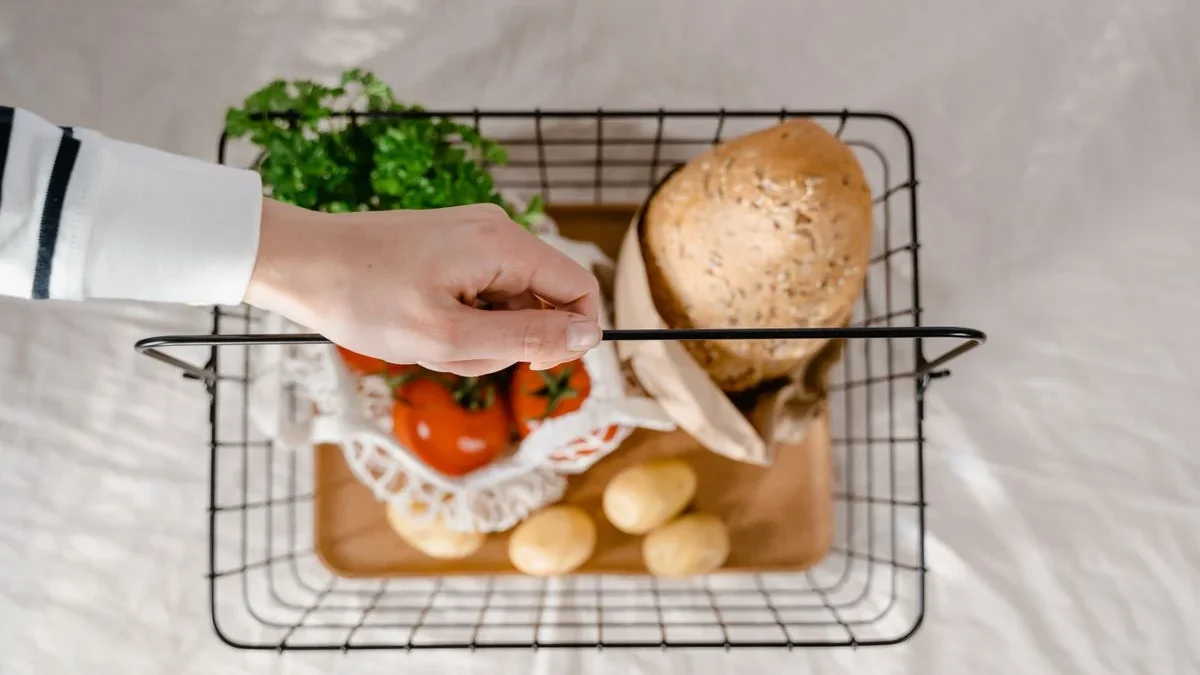
Practical tips and simple tricks for food shopping on a budget to stretch your grocery dollars without sacrificing quality.

First, we took a look in our pantry. This is such a great way to save both time and money. Take a look at your own pantry. Is it organised? Or chaos? If it’s chaos, as ours was, count how many half packets of “stuff” are in there. How many half jars of a sauce did you get to try a viral recipe that ended up tasting horrible or was too involved to dream of making again?
In our pantry we found several half packets of rice, pasta and flour sitting forgotten at the back of the shelf. It made me realise that our clutter wasn’t just food gone to waste. Each forgotten packet was money that could be back in our wallet. Often we’d find a half packet of rice right after we’d just bought a full new packet. It was a disorganised, maddening way to live and our first step in cleaning up our grocery dollars.
Our pantry staple system isn’t fancy or Instagram-worthy like the labelled glass jars of influencer dreams—it’s simple and it works. We got containers from Kmart and labels that we wrote on in our own messy handwriting (yes, there is a container that says “cacao powder” that now houses breadcrumbs but these are small details). We sorted it out. It’s simple but it worked. A container for each of our most-used staples, all filled to the top, to be refilled only when we run out.
Small space, big savings
Like many millennials we had a small home, and with that, a small pantry. We realised that we simply didn’t have the space (physical or mental) to be buying different shapes of pasta every single week. We decided, due to our small space and limited number of containers, that we had to choose three—have a commitment ceremony with them and be done with the nonsense once and for all. The half packets were simply too infuriating.
We chose and I hope you’re happy for us: linguine, spirals and bowties. I’ll admit there are days when I feel like the bowties were a mistake and long for other pasta shapes like spaghetti or those crazy big shells. But to change I would have to empty the jar and rename it, and now, at this stage in my life, this is something I’m simply not willing to do. See, it’s now the system that keeps my hands off the rigatoni, not willpower.
The case for meal planning
Once we had our staples sorted our list was easier to work out. Instead of planning exactly what to serve with each meal every week we started making simpler dishes that work with a few rotating options. For example, my honey soy stir-fry can be served with noodles or rice. This gave us a little bit more freedom without making meal planning complicated. When we shopped we would simply see what staples were low, stock up on that and then decide in the moment whether it was going to be brown or white rice that night (I know, married life is crazy).
The next step was creating a meal plan that lasted the whole week, including snacks and lunches. One of the things I started doing that really helped our grocery budget go further was intentionally repurpose our leftovers. What we used to do was buy an $18 piece of lamb, eat two-thirds of it and leave the rest in the fridge for “leftovers”. But we wouldn’t really eat them regularly—we’d either forget about them long enough for them to go bad (oh no, better get takeaway) or my husband would eat them hunched over the kitchen bench with tomato sauce in a post-work hunger frenzy.
Get creative with leftovers
We don’t like eating the same thing two nights in a row so I started incorporating leftovers into our second-night dinners and making them even better than our first. Those lamb leftovers became lamb wraps with homemade tzatziki or Greek-style rice bowls. Leftover beef from a slow-cooker meal became a pie or the leftover chicken became a pasta dish on night two.
Plus, I marked the leftovers and gave rigorous instructions that they were not to be eaten. Rather than serving boring, groan-inducing leftovers, I started taking pride in the fact that our second-night dinners received a better reaction than the first. That’s the way to get people to eat leftovers—you have to make them appealing.
A great tip if you live in a family of magpies that will peck at your leftovers until they disappear, is to portion the amount you need for the next night first. That way, everyone can serve themselves and your leftovers are protected (unless, of course, you have teenage boys—in that case I would forget about the concept of leftovers for the next five years).
Money-saving food hacks
We started using heaps of little hacks to make our food go further. Here are some of my favourites:
Load up your meals with more veggies
When I started making my own curries I’d add beef but also sweet potato, cauliflower, snow peas, broccoli and anything I could find. This helped bulk up the meals so they could stretch into lunches without using so much expensive meat. Lentils are also great for this. I add half a cup to my butter chicken and I swear no-one notices (a health and budget win!)
Buy ingredients that can be used across multiple meals
This meant that we could use the veggies we bought across multiple nights so we weren’t left with half an eggplant in the fridge with no use for it.
Keep your meals simple and try to eat similar things week to week
There will always be something new and shiny to try but half the time the recipes aren’t even good or require heaps of ingredients. We focused on making meals that were similar to the ones our parents made us when we were growing up—meat, veg and a pantry staple or potatoes—and cut out any unnecessary ingredients. We were able to eat filling, nourishing meals but we weren’t trying to be Jamie Oliver, especially not on weeknights with a baby.
Get growing
A great way to add flavour to your meals at a minimal cost is to have a herb garden. Starting ours was the best decision ever. We began with rosemary and thyme and now also have parsley and coriander. We also have an investment lemon tree, which we swear is going to start paying dividends any day now—until then we source lemons and limes from my parents’ house. Small things, but the little dollars do add up.
Plus, just like making food ourselves, growing food also made us feel great about ourselves. My husband grew up with the most incredible family veggie garden. His dad grew everything and beamed when he handed us some homegrown zucchini or garlic. He even made and jarred his own relish. While I was always grateful for the food, I don’t think I quite understood it until now.
We’ve become so disconnected from the way food is made that we don’t value it as much. If you spend six months growing and tending to your own homegrown veggies, I can tell you, you’d never let them go bad in the fridge.
Our unit’s backyard is probably smaller than one of my father-in-law’s pumpkin planter boxes but we did what we could and made our little herb garden. Plus, we’ve just seen our first yield of spring onions.
Dietitian Marcia Townend shares seven backyard garden tips that actually work.
Buying herbs from the supermarket is maddening because (1) they’re expensive and (2) you always get more than you need, leading to wasted food and money. It’s a small step but a great one. And yes, we feel very proud of our tiny, flourishing herb garden. Just like our savings, it started with a small sprig.
Spend more to save more
The last thing we did to reduce those little pop-in shops seems counterintuitive—we increased our weekly grocery spend. It turned out trying to keep that main shop as low as possible was biting us in the long run, leading to multiple additional shops, all of which added up. Spending a bit more on our main shop and really thinking about what we were going to eat during the week meant we weren’t running out of food by Tuesday.
We found out that spending $40–$50 more on the main shop meant our total grocery spend was still about $100 less for the fortnight. We also allocated Thursday as our “top-up” shop, taking the pressure off having to get everything right on the weekend shop. But we also make a list for our top-up shop—and if it’s not on the list, we don’t buy it.
What surprised us most in spending less on our grocery shop is that we were happier. Knowing what we were going to eat and not wasting our evenings on endless trips to Woolworths and Aldi reduced the mental load. Making a plan to bake cookies at home to resist the urge to purchase at a café was better—the cookies were nicer and the $5.50 saved was even sweeter.
We felt better about seeing an empty fridge at the end of the week, knowing that we’d planned well for what we would actually eat rather than overconsuming. Being more prepared was saving us time, money, sanity and reducing our environmental impact.
Keep the fun
I’d also like to note that we didn’t give up our “treats” on a Friday night—after all, what’s life without a Friday night chocolate? But we changed it slightly and rolled them into our allocated Thursday night top-up shop. And we only allowed ourselves to buy things on special. Again, these are very small steps but changing all of our micro-moments of overspending and indulgence was helping us both feel in control and allowing a few dollars back in our wallet.
Read next: 12 kitchen swaps to save money and the planet

This is an edited extract from Thrifty Rich by Lou Gibson, published by Penguin Books.