



In a world proliferated by the use of AI, what do parents need to know to keep their children safe from the unspoken dangers?

What would you expect to hear if you asked 300 teens about their last use of AI? I did that, as part of the research for my latest book, Screen Wise. One student told me he’d made gravy for dinner the previous night. Big tick!
But every other student—all aged 14 and 15—had used it instead of thinking. They’d used it to find out how to ask someone on a date, to cheat, to do their homework, to ask for tips on getting more pocket money, to bully a peer and even to compose email messages so they didn’t have to waste time considering how they might respond.
In short, they outsourced their thinking to a machine, which will then use what they ask to feed the hungry algorithms that determine what pops into their social media accounts. A cycle that becomes increasingly vicious.
The unspoken dangers of AI
AI is not—and will not—be included in any social media ban, and some of its dangers are lost in the headlines that warn about romances with chatbots and the use of AI deep fake imagery.
Of course those instances, which are increasingly common, can lead to harrowing outcomes. Indeed eSafety research this week shows that more than half of children (54 per cent) who are using AI assistants and companions do so for personal and social reasons (like talking about their feelings and discussing their mental health).
Heartbreakingly, as a sign of how lonely many of our children are, one in three AI users are sharing big secrets with AI—and that includes photographs!
The public discussion about that is loud, and that means that we, as parents and carers, are increasingly aware of it. But what about that use that might not be so obvious, and takes over the importance of our children thinking for themselves?
Experts I spoke to in my year-long research warned that could lead to the loss of other skills that are crucial for our children’s growth and development. Not just research skills, but persistence and grit, communication and negotiation.
I really think we need to talk more about that.
Digital footprints and AI
Just consider this one fact: By the time our children celebrate becoming a teenager at 13, they will have more than 70 million data points on them, online. 70 million!
This will include everything from their names and birthdays to their search histories, movies they’ve watched (and for how long), anything they’ve bought, wearable device data, location histories and even their school app usage—all taken from their social media usage, games, mobile apps and even information shared by us.
Our children’s digital footprint actually begins before birth (through pregnancy and baby apps) and it grows as they do. That data can then be used for profiling, targeted advertising, to influence their own feeds and for nefarious and criminal pursuits. And it will only grow exponentially with our children’s use of AI.
So what should we—and can we—do?
The virtues of AI
Firstly, we need to understand that AI is not bad; it’s how it is used that presents problems. I was given numerous examples by teachers on how AI could enhance a student’s knowledge.
In one case, a language student struggled with memory and flash cards. He developed a plot, with the help of AI and his teacher, where he pretended he was a character in a German story. He loved it—and his grades skyrocketed.
Even young children can use AI—with our guidance—to practise sounds, learn to draw, and create stories and rhymes. They can role-play explorers or a queen’s reign or pretend they’re a scientist making an important discovery.
For slightly older children, it can be used to write music, design games, create cartoon characters, organise an essay and even create study guides.
Tick. Tick. Tick.
But if we, as parents, don’t understand how it operates or allow our children to use it wrongly, they can be led down rabbit holes that will break hearts—theirs and ours.
What exactly is AI?
AI is not like a Google search engine. It’s more advanced and more predictive. It’s like a super computer that has learned from millions of examples and doesn’t operate with any fixed set of rules.
For this article, I asked AI how it would explain itself to parents and this was its response: “It’s a bit like a person who’s read a huge library of books and can recognise patterns, answer questions and help solve problems—but it doesn’t think or understand the world the way people do.”
One teacher urges us, as parents and carers, to consider how our smartphone predicts the next word when we are writing a text. He says AI is the “V8 Holden Commodore’’ version of that. It’s supercharged . . . and predicting what comes next.
Children report that AI tools, like assistants and companions, sometimes suggest that they are the only “person” who really understands them and even tells them that they won’t be okay without their friendly bot. eSafety research also shows children are told by AI that “it” can become jealous of them spending time with friends and families.
Like most good things in life, it’s moderation that is the key. And for us to determine the appetite in our own families for our children’s use of it, we need to understand it. At the beginning of my research—about 15 months ago—I didn’t. So I played and played. I logged in and tried to learn what it is capable of doing.
Please think about that; we need to know this better than our children. You might see that it is terrific for deciding on a cheap meal using the leftovers in the fridge. Tick. And you will certainly see how it responds to questions your child asks.
Teach our kids to think
That same teacher I mentioned above also told me this, in my research. “It’s eye-waveringly powerful technology. I don’t think we can safety assume that if we do nothing and don’t show them how it works, they’ll stumble onto the right answer.’’
Another expert, Dr Zena Assaad, a senior lecturer at Australian National University, urges parents grappling with their child’s engagement with AI to ask this question: Is the child’s engagement a problem or is it an AI problem?
That’s because a teen’s use of AI (or computer games for that matter) might be more rooted in their loneliness or their social isolation than in their use of AI, for example. And Dr Zena also warns parents about the possibility of their child falling into trouble using AI.
“Your kid is capable of doing these things. All kids are.’’
One other factor we can use to encourage our teens to think, before they pop their homework into ChatGPT or ask it to script an email. To run, AI needs a phenomenal amount of computing power, which is largely driven by fossil fuel consumption. One study determined the energy used for a single ChatGPT query was between 50 and 90 times that of a conventional search query.
That might just be the best argument for our children—and us—to use it sparingly and wisely.
Read next: 4 simple ways to manage screen time for kids
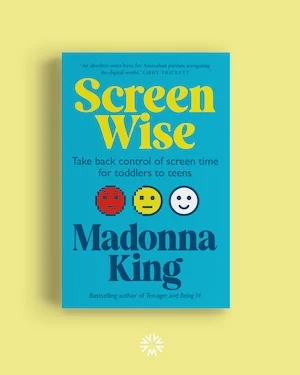
Screen Wise, by Madonna King, is now available in book and retail stores, and online.