

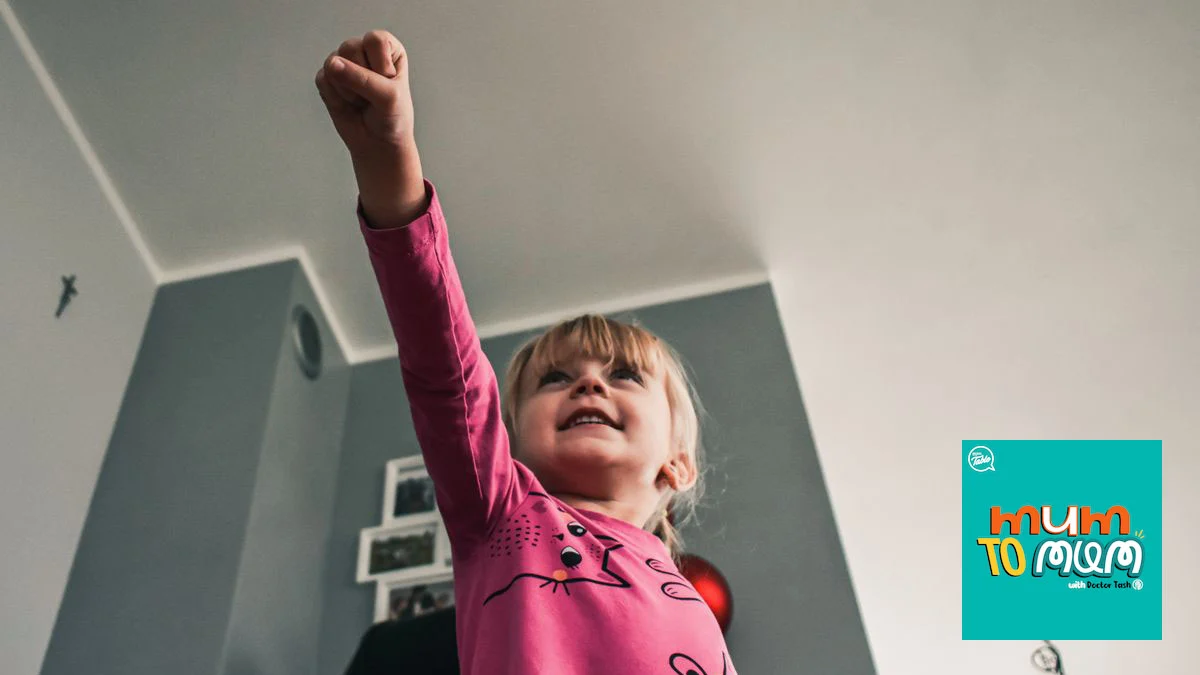
Stop rescuing and start empowering. Discover how to help your child build lifelong resilience by “struggling in safety” alongside you.

I still remember the first time my son climbed out of the foam pit in his gymnastics class. He was two years old and had only recently started the class. The first couple of weeks, I had helped pull him back up after he’d jumped in, but this day was different. I had jumped in as well and found myself in the middle of the foam pit, as far from the edge as possible. He was half-a-metre from me and a fair distance from the edge.
“Mama, help me,” he exclaimed, frustrated as his attempts to move didn’t seem to get him anywhere.
I paused for a moment. We had a bit of distance to cover before we could get out, so instead of rescuing him straight away, I wanted to see what he would do.
“I know, it’s so hard, isn’t it?” I said, throwing my arms out. Then I gave an exaggerated sigh before continuing, “Okay, let’s do it together.”
I started climbing out beside him, making exaggerated struggling sounds as I clambered, as though it were much harder than it really was.
“It’s hard, Mummy’s working hard, really, really hard.”
He laughed. Then he started copying me. “Working hard, really, really hard”.
From frustration to independence
He had moments of little grunts and bursts of frustration as he worked his way over the bigger foam pieces. Eventually, we reached the edge and he managed to climb out without my help.
The following week, he got frustrated again. This time, I wasn’t in the pit. From the edge, I acknowledged and encouraged him again. “It’s so hard. You’re working really, really hard.”
And this time, that was enough. He turned back, repeating it to himself as he climbed. “Working hard, really, really hard.”
Since then, he usually climbs out on his own, often declaring it as he goes. There are still moments of frustration but now, a few words of encouragement are usually enough to steady him.
That moment stayed with me.
What I had observed in my son wasn’t just frustration, he was learning.
Learning through frustration and struggle
There is a kind of struggle that leads to growth. The kind that comes with a new challenge, something just beyond our comfort zone, but still attainable.
In children, it’s the kind of struggle where they feel stretched, but still supported. Where things feel hard, but not impossible. Where it’s a challenge, but they do not feel defeated. It is not overwhelming, and they still feel safe and connected, even through the struggle. This sort of struggle is actually a positive experience for kids and adults alike and encourages growth and development.
This was the frustration my son felt that day. It was a safe struggle and this is where resilience begins to grow.
What is a safe struggle?
This really comes down to the connection and whether the child feels emotionally supported in that moment.
Every child has a different temperament and tolerance level, shaped by their experiences and family environment. There is no one-size-fits-all here. Even within the same child, that tolerance can fluctuate depending on the moment.
So, our role is to stay attuned, to notice where our child is at that moment, and to respond in a way that keeps them feeling seen and supported. What one child can tolerate, another may not and that is okay. Each child is their own unique self and so the key to ask is, “Is this tolerable to this child at this time?”
Not all struggle is helpful
Now it is important to recognise that there is a difference between being challenged and being overwhelmed. When a child is in a tolerable struggle, they are still engaged. There may be frustration, but they are still trying, and importantly, they feel supported.
However, when a child becomes overwhelmed, something shifts. They may become distressed, shut down, lose the ability to continue or call for help in a way that tells you they are no longer coping.
At that point, the role of the parent changes. It is no longer about holding space for the struggle but rather stepping in to support them through it. Stepping in doesn’t automatically mean a full rescue is required. The goal is to stay attuned to what the child needs and respond accordingly.
Sometimes that might mean helping more. Sometimes it might just mean doing it together. And sometimes it might mean doing it for them.
This overwhelm can occur over something seemingly small, such as a young toddler trying to tie their shoes who throws themselves down saying, “I can’t do it, I can’t”, while crying and refusing to continue. In this moment, it might be enough to say, “Okay, let’s do it together”, and guide them through it. Or it might mean stepping in more fully.
Remember, there is no one-size-fits-all and that is okay. The goal is not to force independence, but rather allow resilience to develop within safety, in a timeframe that works for that individual child.
If you’ve ever felt that pang of guilt while watching your child struggle, you’ll want to hear the full conversation on the podcast where we dive deeper into the “invisible” work of building a resilient heart.
What this looks like in everyday moments
I was in the kitchen preparing dinner with two of my children nearby. My toddler was helping me chop up a zucchini for the first time using a child-safe cutter. At the same time, my baby was on the floor nearby, in that stage where she’d recently learnt to roll, but wasn’t yet consistent or smooth in doing so.
At one point, chopping the zucchini became difficult for my toddler. I could see that he was struggling. There was effort and some frustration, but he was still engaged. He began using the same language I had used with him previously. “Working hard, really really hard.” He persevered and eventually succeeded. There was a clear sense of accomplishment in that moment.
At the same time, his sister had rolled over and gotten herself a little stuck. She was frustrated but still trying; there were little grunts and bursts of frustration as she attempted to free her arm.
I didn’t rush in to rescue her, although I wanted to. Instead, I acknowledged her experience. “Oh baby, it’s hard isn’t it. Your arm is stuck. Mummy’s here, you let me know if you need my help.”
She was frustrated but not distressed. It was still a tolerable level of frustration. There was one point where I thought it might be escalating and I was about to step in. I had still been cooking though and at that moment I had needed to wash my hands first.
As I turned back toward her, she succeeded. She rolled onto her back and looked up at me, her face full of joy. She had done it.
As I reflect on that moment, I realise it was actually after that day that rolling became her norm. It no longer seemed like a struggle in the same way.
Both of my children had been faced with a challenge. Both experienced frustration. Both persevered. And in doing so, they experienced what it feels like to work through something difficult. And importantly, they did it while still feeling supported.
This is the balance we are constantly navigating as parents. Not stepping in too quickly and removing the opportunity for growth but also not leaving our child to struggle beyond what they can manage. Staying connected and ready to step in whenever it is needed.
Why does this feel so hard?
We often feel like we need to step in straight away when our child is struggling. We love our children and there is a natural instinct within us that wants to protect them from discomfort. When they are frustrated or upset it can feel like something has gone wrong, like we should be fixing it.
But that’s the thing. Sometimes our children don’t need us to “fix” anything; they simply need to know that they aren’t alone in it and that you’ll be there to help when they really need you. And this is where the challenge lies.
We then find ourselves wondering:
- Should I step in?
- Am I leaving them too long?
- Am I rescuing too quickly?
Now let’s be honest. Answering those questions can feel hard because it is hard! It is incredibly hard learning to best navigate that tension. And here’s the truth: There is no single right answer. It is a moment-to-moment assessment.
Final takeaways
Not all struggle is bad and not every moment of frustration needs to be removed. What matters most is not that the struggle disappears but that the child does not feel alone in it.
A child can feel frustrated and still feel supported.
A child can be challenged and still feel safe.
Resilience is not built by removing struggle.
It is built in those moments when something feels hard and a child discovers that they can move through it, while still feeling supported and not alone.
Tune into the Mum to Mum with Doctor Tash podcast

Parenting isn’t easy and some days, it feels downright impossible. That’s why Mum to Mum with Doctor Tash is here: honest, heart-centred conversations about raising emotionally healthy kids, one connection at a time. Join paediatrician Doctor Tash (Natasha Ching) and host Melody Tan as they unpack the big emotions, everyday struggles and lightbulb moments that come with modern parenting. From tantrums to teen moods, from discipline to self-compassion, each monthly episode offers practical wisdom grounded in science and guided by empathy. This is the place where you’ll find understanding, not judgement. Real talk, not quick fixes. Because parenting isn’t about perfection—it’s about learning, growing and connecting.
NOTE: The information shared in this article and the podcast does not constitute medical advice. It is for general and educational purposes only. Please consult a qualified healthcare professional for advice specific to your situation.