

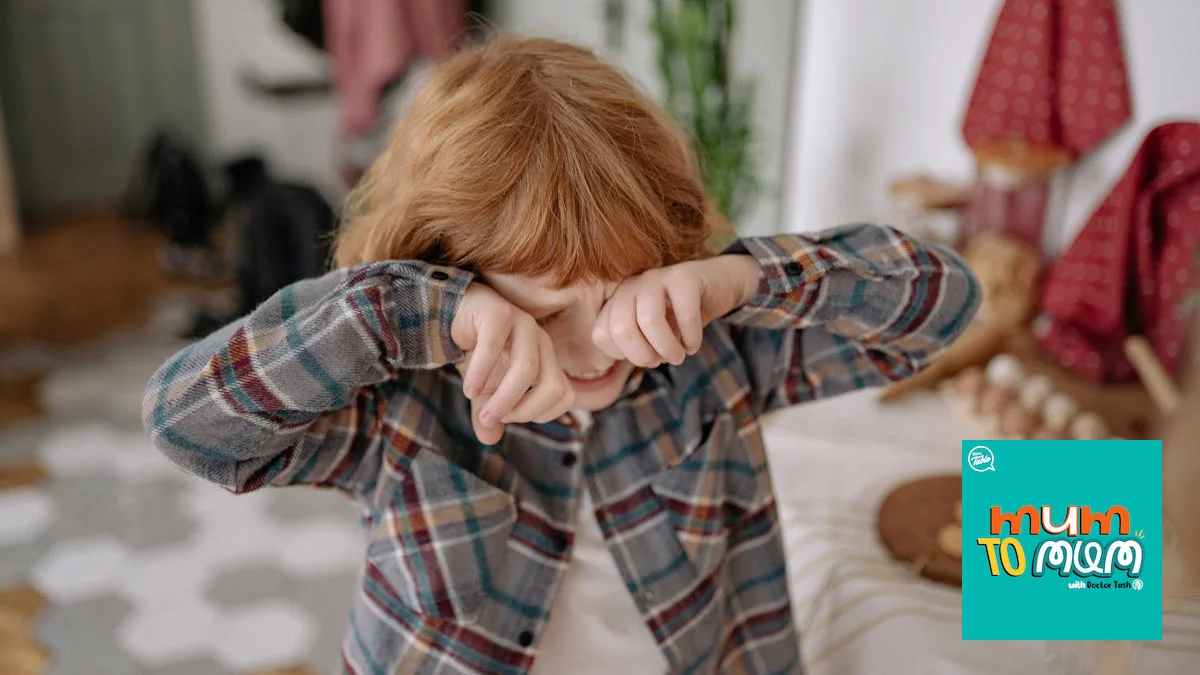
Sometimes crying isn’t something to fix—it’s the release your child needs. Learn how holding space for tears builds connection and calm.

There was a moment in the early days of parenting my first-born that I will never forget. My son was just shy of one month old, it was in the early evening and I just couldn’t get him to stop crying. He was fed, bathed, nappy changed, not too hot or cold, not due to sleep . . . his “needs” appeared to be met.
I tried everything to no avail. He kept crying and I couldn’t settle him. I kept wondering, Am I missing something?
After some time, my husband was eventually able to settle him to sleep with some bouncing and singing. I remember sitting there and thinking to myself, What is wrong with me, I can’t even settle my own baby?
Honestly, I felt like a failure of a mother and because of my profession, it extended to, If I can’t settle my own baby, then what sort of paediatrician am I? I was having a true identity crisis.
Not always a problem to solve
At the time, I was looking at crying as a need to be fixed, something to be solved and stopped, but in doing so at the time, I was failing to appreciate a really important truth: Sometimes, what they need is simply the chance to cry.
Most people can appreciate that babies cry as a way to communicate their needs, but what may be less appreciated is that sometimes, it isn’t a problem to be solved, but is the actual need itself.
Think about it. As adults, we all have times in life that leave us feeling like we need an emotional release. Sometimes it’s overstimulation from having way too much on our plates to juggle, even if it’s all positive. Sometimes it’s under-stimulation or feeling like we haven’t done enough. Why should children be any different?
Before going further, it’s important to be very clear about something. In newborns and young infants especially, persistent, unusual or inconsolable crying always deserves thoughtful assessment. If something feels different, severe or just not right in your gut, trust that instinct and always get a medical review. I am not suggesting all crying is emotional release. It’s about recognising that when medical causes have been excluded and basic needs are met, sometimes the cry itself may be part of the process.
Crying, stress and the nervous system
Can you recall a time when things just seemed overwhelming and too much? Too many work expectations, financial stress, failing to meet expectations (others or your own) or just feeling like everything was just too much? Did you cry? If you did cry, how did you feel afterwards?
If you are able to recall a time when everything built up and you had a massive cry, you would likely also be able to recall feeling less tense or having a great sleep or rest afterwards. Many of us have experienced this personally. When everything builds up and we finally cry, we often feel lighter afterwards.
In adults, emotional crying in a safe and supportive environment has been associated with a reduction in physiological stress and a greater sense of calm. With infants, we don’t have the same biological mapping in place in the research literature. What we do know though, from developmental and attachment research, is that when distress is met with calm, responsive presence, the nervous system settles over time. That’s co-regulation.
The power is not in “crying alone”. It’s in crying while held in connection.
Understanding this truth was liberating for me as a mother. I was able to separate my self- worth from my child’s tears and to instead embrace the power of being with my child whilst they got out their tears.
I remember the first time I did this for my second child. He was just over two weeks old at the time. Similarly, he was fed, bathed, nappy changed, not too hot or cold, but he was still fussing. I decided to give him the opportunity to cry. I didn’t try to rock, bounce or jiggle, I didn’t try to stop him from crying, but instead, I held him in my arms, told him, “Mummy’s here, you can cry if you need to”, and then held him in my arms whilst he cried. No fixing. No distraction. Just a calm presence.
He cried loudly for 20 minutes and then peacefully settled to sleep. After that release, he settled beautifully. Over the next day, he seemed calmer and more settled in himself generally.
Tears are not always something to stop. Sometimes they seem to be part of what allows the body to settle. In that moment, the release seemed to be what he needed.
Why their cry might stir something in you
There’s another reason many of us struggle to allow crying. It’s not because our child is broken, but because it awakens something within us.
Many of us grew up with messages of “stop crying”, “don’t be a baby” or “you’re too sensitive”. Those messages don’t simply disappear, even if we’ve done the work to reach the point where we no longer believe them to be true. These messages can be deeply rooted in our nervous system and our children’s crying can be the trigger to bring up the feeling we internalised during our own childhood.
As a result, between the historical messaging and the physical discomfort felt, crying can feel like failure, rejection or loss of control.
If you often find yourself desperately wanting to stop your child’s crying, pause and reflect: What’s going on for me in this? To be able to “be with” our children’s tears, we often have to heal our own relationship with crying.
The broken cookie phenomenon
The need to cry doesn’t stop with babies. There have been so many moments with my son where there has been a meltdown over something seemingly trivial: Yoghurt being put on top of the porridge instead of next to it, the fact we didn’t stop at the grocery store on the way home from school, the gingerbread cookie being broken.
It’s important to recognise that specific illustrations in older children should not be over-generalised, as each child’s needs and reasons for crying can be very different. For some kids, there are other reasons for their responses and reactions.
However, to try to speak to the concept and my experience in my illustration, there are times where on the surface, it may seem like an over-the-top reaction, potentially disproportionate or out of character. Sometimes, these moments have nothing to do with the moment but are simply the tipping points.
Want to hear how this plays out in real life? Listen to the full Mum to Mum with Doctor Tash episode on why crying isn’t a problem to solve.
The broken cookie phenomenon states that it’s rarely about the cookie. More often than not, my child is carrying tension. This could be from a big day at school, social stress, sibling transitions or feeling disconnected. There are plenty of potential scenarios that can cause a degree of discomfort or stress. There’s tension.
In a way, he’s looking for an excuse to let it out in a safe place. A way for the nervous system to offload accumulated stress. There are many times when I myself have struggled to hold the space of safety and just let the tears come. Busyness. Struggling to manage my own triggers. Impatience.
When I can hold space and let the tears come, I’ve noticed that they’re often followed by a greater sense of connection, peace and calm. In contrast, when I don’t, the tension seems to go on for hours, days or weeks, usually manifesting in different “behavioural” upsets until the opportunity for safe release is truly given.
How to be with the cry
Firstly, and especially true to young mums with newborns and infants, know this: The fact that your child is crying does not mean you are failing. Within this, stay in tune to your own body and mind. What are your needs at this moment?
It’s hard to offer calm when your own nervous system is overloaded. The best thing that you can do for your child in these heightened moments is be a calm leader. In order to do that, sometimes you need to tend to your own needs first to be able to find calm. Allowing a pause, a breath, to step away when extra triggered for an adult time-out or reset.
Even if you’re calm, it’s important to remember they won’t be. That’s the point. You are being the calm they cannot find otherwise at this time. In terms of what to then do or say, this is subjective. Each child will respond differently. For some, less is more, as words can be triggering and the best you can do is just be present (take note, that doesn’t mean you’ll be thanked for it). For others, acknowledging and validating what they’re feeling can be immensely helpful. There is no-one-size-fits-all and it’s a lesson learnt through trial-and-error.
Final takeaways
For some, this may already be intuitive. For others, like me, there could be a need for a real mindset shift.
Next time your child cries and it seems like the cry itself might be the need, I invite you to pause. Not to fix it, not to distract, not to hurry them through it, but to simply be present. To let the tears come. Crying doesn’t mean failure. Not for you and not for them.
Sometimes it’s part of how the body processes stress and comes back into balance. And in this, it’s important to remember what we’ve said about so many things before: You won’t get it right every time. And that is okay. Perfection is never the goal. Parenting is a never-ending journey of personal growth and learning. Let’s normalise tears, not as weakness, but as part of being human.
Tune into the Mum to Mum with Doctor Tash podcast

Parenting isn’t easy and some days, it feels downright impossible. That’s why Mum to Mum with Doctor Tash is here: honest, heart-centred conversations about raising emotionally healthy kids, one connection at a time. Join paediatrician Doctor Tash (Natasha Ching) and host Melody Tan as they unpack the big emotions, everyday struggles and lightbulb moments that come with modern parenting. From tantrums to teen moods, from discipline to self-compassion, each monthly episode offers practical wisdom grounded in science and guided by empathy. This is the place where you’ll find understanding, not judgement. Real talk, not quick fixes. Because parenting isn’t about perfection—it’s about learning, growing and connecting.
NOTE: The information shared in this article and the podcast does not constitute medical advice. It is for general and educational purposes only. Please consult a qualified healthcare professional for advice specific to your situation.