

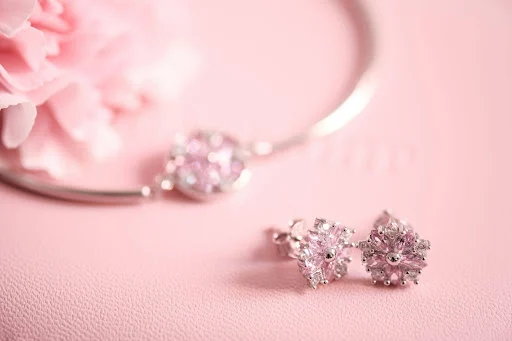
Thinking beyond the share market? Discover why pink diamond rings and loose stones are turning heads as a serious alternative investment—and what you need to know before you buy.

There’s a moment most of us have had—standing in a jewellery store, trying on something impossibly beautiful, then quietly putting it back because spending that kind of money on something decorative feels impossible to justify. But what if that thinking is worth revisiting?
Pink diamonds have been quietly doing something extraordinary over the past two decades: Appreciating in value in a way that has made serious investors sit up and pay attention. And unlike shares or property, they come in a form you can actually wear. Pink diamond rings, in particular, have become a point of entry for buyers who want to combine the pleasure of owning something beautiful with the pragmatism of a long-term store of value.
So, is this just a trend—or is there a genuine financial case to be made? Here’s what the numbers and the experts suggest.
The supply story is genuinely remarkable
To understand why pink diamonds hold and grow in value, you need to understand where they come from. For decades, the overwhelming majority of the world’s pink diamonds—around 90 per cent—came from a single source: The Argyle mine in Western Australia, operated by Rio Tinto.
In 2020, the Argyle mine closed permanently after more than 35 years of production. It wasn’t a decision based on falling demand. The resource was simply exhausted.
What this means in practical terms is that the global supply of new pink diamonds has fallen off a cliff. No other mine in the world produces them in meaningful quantities. Diamonds are still being found elsewhere, but the vivid, intense pinks that made Argyle famous are, for all practical purposes, finished.
When supply contracts sharply and demand either holds or grows, prices tend to move in one direction. That’s not speculation—it’s basic economics.
What the data shows
The Argyle mine’s annual tender—an invitation-only sale of its finest stones—became a reliable benchmark for pink diamond values over the years. Prices at that tender grew at an average of around 15 to 20 per cent annually across much of its history, with some exceptional years doing considerably better.
Since the mine’s closure, the trajectory has continued upward. Collectors and investors who purchased Argyle pinks before the closure have seen substantial gains, and market analysts tracking coloured diamond prices expect the appreciation to continue given the structural supply constraint.
This is not the kind of asset class that suits everyone. Pink diamonds are illiquid—you can’t sell them instantly the way you might sell shares. The market for resale requires the right buyer, the right platform and some patience. But for those with a longer time horizon, the fundamentals are compelling.
How this fits into a broader financial strategy
Financial advisers increasingly talk about the importance of asset diversification—spreading wealth across different types of holdings so that a downturn in one area doesn’t wipe out everything. Traditional portfolios lean heavily on shares, superannuation and property.
Alternative assets—which include things like art, wine, watches and precious stones—occupy a different space. They tend not to move in correlation with the share market, which means they can provide a buffer when other investments are struggling.
For a mum thinking about long-term financial security—whether that’s building wealth for retirement, creating something to pass on to children or simply holding value outside the volatility of the ASX—a single high-quality pink diamond can represent a meaningful addition to the mix. It won’t suit every budget, but the entry point is broader than many people assume. Smaller stones of half a carat or less can still carry investment value if they’re well-certified and sourced appropriately.
What to look for—and what to watch out for
If you’re genuinely considering pink diamonds as an investment rather than purely as jewellery, a few principles apply.
Certification is non-negotiable
Any stone worth serious money should come with a grading report from a recognised gemological laboratory—the Gemological Institute of America (GIA) is the gold standard. The report documents the stone’s colour, clarity, cut and carat weight, which are the factors that determine value.
Colour intensity matters enormously
Pink diamonds are graded on a spectrum from Faint through to Fancy Vivid. The deeper and more saturated the colour, the rarer and more valuable the stone. A Fancy Vivid pink can command a price many multiples higher than a stone of the same size with a lighter hue.
Provenance adds value
Argyle-certified stones—those that came with Argyle’s own authentication documentation—carry a premium in the current market specifically because of the mine’s closure. If you’re buying a stone described as Argyle origin, make sure the documentation supports that claim.
Buy from reputable dealers
This is not the category for eBay bargains or impulse purchases. Established coloured diamond specialists, auction houses with dedicated jewellery divisions and dealers who offer independent certification are all safer entry points than the secondary market without documentation.
The emotional dividend
Here’s the part that makes pink diamonds different from most investment assets: They’re genuinely lovely to own.
A share portfolio or a managed fund is abstract. A pink diamond—whether it sits in a ring you wear daily or is stored safely in a security box—is tangible. You can hold it, look at it and appreciate it in a way that a spreadsheet simply doesn’t allow.
For many women, that combination of beauty and financial substance feels meaningful. It’s an investment that reflects both practicality and a certain refusal to choose between the two.
That’s not to say every woman should run out and buy one. Like any investment, pink diamonds carry risk—values can plateau, markets can shift and liquidity remains a real constraint. The smartest approach is to treat them as one part of a diversified strategy, not a silver bullet.
But if you’ve ever admired a pink diamond ring and wondered whether the pleasure of owning it could also make financial sense—the honest answer is that for the right buyer, with the right stone and the right horizon, it genuinely can.
Read next: How to save money and grow wealth at any stage of life
Always seek independent financial advice before making investment decisions. This article is intended as general information only.