



Discover simple ways to test your kids’ money smarts, teach essential financial skills and get them ready to handle money in the real world.

When most people think about financial literacy, they picture lessons about money, saving and budgeting. While those are certainly important, true financial education is about much more than teaching children how to count coins or fill up piggy banks.
Real financial literacy is about helping kids develop the confidence, financial knowledge and capability to make good choices throughout life.
The challenge is that many parents aren’t entirely sure what financial literacy looks like in everyday life. How do you know if your child is developing the right financial skills? And if money isn’t something you feel particularly confident about yourself, how do you help set them up for a stronger financial future?
Instead of focusing on what your child knows, it can be helpful to focus on what they can do. Here are 15 signs your child is developing strong financial literacy and the good financial habits that support long-term financial wellbeing.
1. Can they explain where money comes from?
Many children grow up seeing tap-and-go payments, online shopping and digital transactions without ever seeing much physical cash. A child with growing financial literacy understands that money is earned through work, providing value, running businesses or investing. They understand that money doesn’t simply appear when a card is tapped. This is one of the most important financial concepts for young people to learn at a young age.
2. Can they tell the difference between a want and a need?
If your child sees something they like in a shop, can they recognise the difference between wanting it and actually needing it? Understanding wants and needs helps kids make better financial decisions and encourages more thoughtful spending throughout everyday life.
3. Can they save towards a goal?
Whether it’s a bike, concert ticket, sports equipment or their first car, learning to work towards financial goals is a key part of financial education. Many children start with piggy banks, while older ones may use a savings account. The method matters less than the lesson: Setting a target, making a plan and sticking with it. Developing good financial habits around saving can have a lasting impact on future financial success.
4. Can they wait before making a purchase?
Modern technology has made spending money easier than ever. Can your child pause before buying something and consider whether they still want it tomorrow? Learning delayed gratification helps young people avoid impulse purchases and make smarter choices with their money.
5. Can they create a simple budget?
A budget doesn’t need to be complicated. If your child receives pocket money, birthday cash or income from a small job, can they decide how much to spend, how much to save and how much to set aside for future plans? Simple budgeting skills help build confidence with money management and prepare children for greater responsibility later on.
6. Can they earn their own money?
Financial literacy isn’t just about managing money, it’s also about understanding how it is earned. Whether it’s helping with extra jobs, selling handmade items, doing odd jobs for neighbours or working part-time in high school, earning money helps kids connect effort with reward. Many young people develop a stronger appreciation for their spending when they’ve worked to earn the money themselves.
7. Can they explain the difference between debit cards and credit cards?
Many adults use cards every day without explaining how they work. A child developing strong financial knowledge should understand that debit cards use money already available, while credit cards allow people to borrow money and repay it later, but of course with a catch. These are essential financial concepts that support future personal finance decisions.
8. Can they understand that debt isn’t free money?
As kids get older, they should begin learning that borrowing has consequences. Whether it’s loans, buy-now-pay-later services or credit cards, debt can be useful when managed responsibly, but it must be repaid. Understanding this early can help young people make more informed choices about their future finances.
9. Can they compare value, not just price?
The cheapest option isn’t always the best option. Can your child compare two things and explain which offers better value? This skill becomes increasingly important as young people encounter advertising, brands, and a growing range of financial products and consumer choices.
10. Can they learn from a money mistake?
Most adults can remember a purchase they regretted. The same should be true for kids. Positive financial behaviours often develop through experience. A disappointing purchase can teach lessons that no lecture ever could. Learning from mistakes is an important part of building financial capability.
11. Can they understand how a savings account grows money?
A child doesn’t need to become a banker to understand the basics. However, they should know that a savings account can earn money through interest rates and that compound interest allows savings to grow over time. Teaching compound interest at an early age can have a significant impact on financial futures.
12. Can they talk openly about money?
For many generations, discussions about money were considered off-limits. Today, more parents are helping children understand money management through open conversations about spending, saving, goals and decision-making. The more comfortable kids become discussing money, the more likely they are to make informed decisions as adults.
13. Can they recognise social pressure and marketing?
As young people move through school, social influences become stronger. Friends, trends, brands and advertising can all affect spending choices. Financially capable children learn to question whether they genuinely want something or whether they’re simply feeling pressure to fit in. This awareness helps support smart financial decisions and healthier money habits.
14. Can they understand trade-offs?
One of the most practical financial skills is understanding that every choice has a consequence. Spending money on one thing often means not having enough for something else. Children who understand trade-offs tend to make more thoughtful and informed financial decisions because they can see the bigger picture.
15. Can they think about their future self?
Perhaps the ultimate sign of growing financial literacy is the ability to think beyond today. Can your child connect today’s choices with tomorrow’s opportunities?
Learning to care about their future self encourages better financial planning, stronger personal financial management and helps build the habits that contribute to long-term financial security, financial stability and eventual financial independence.
The goal isn’t perfection
No child will master every item on this list overnight. Financial literacy develops gradually through conversations, experiences and opportunities to practise. Some younger children will naturally enjoy saving, while others learn best by making mistakes. Some kids will become planners, while others will need more guidance along the way.
The important thing is helping children build positive financial behaviours, strong financial capability and good financial habits that support lifelong financial wellbeing.
One day, today’s kids will become adults making decisions about bank accounts, mortgages, investments and their own families’ finances. The lessons they learn now can shape their financial futures for decades to come.
Ready to test your kids’ money smarts?
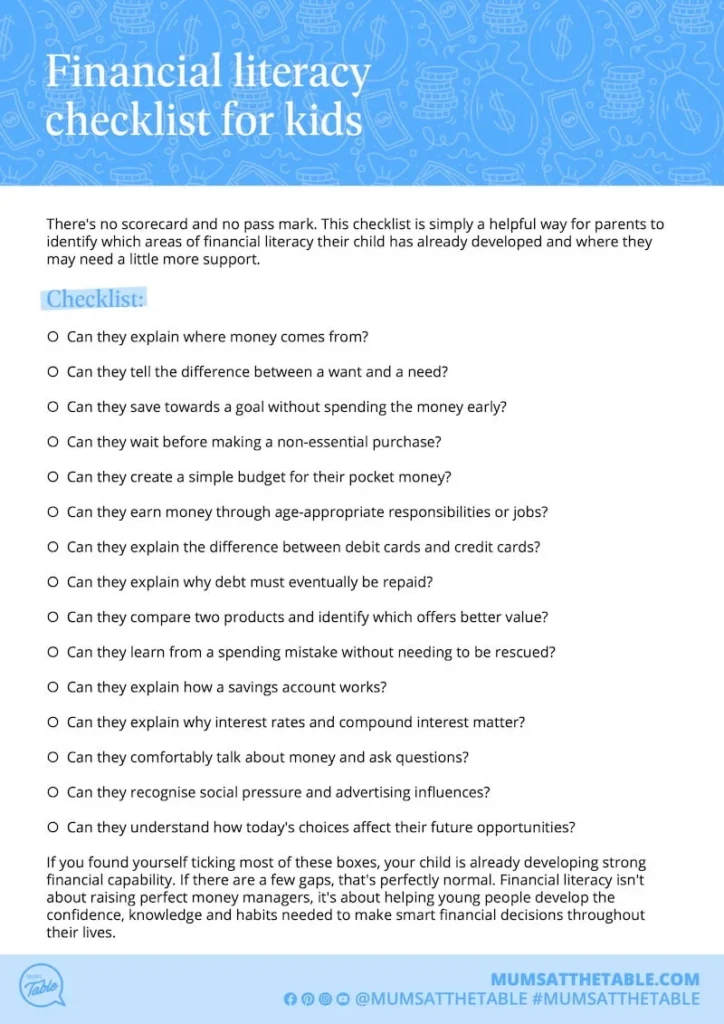
Where is your child on their money journey? Whether you’re trying to explain where tapped card money actually comes from or introducing pocket money for the first time, our printable checklist gives you a stress-free roadmap.
More articles on teaching financial literacy